
Date published: September 26, 2025
Date modified: October 13, 2025
Author: Shea Mencel, Certified Integrative Health Coach & Co-founder, We Are Here
Stress is not just an individual experience. It is a physiological force with measurable effects on nearly every system of the body. Chronic stress can alter cardiovascular function, weaken the immune system, disrupt digestion, accelerate aging, and contribute to conditions ranging from diabetes to cancer (1,2,3).
For patients navigating serious illness, these impacts are amplified. But stress isn’t just a personal burden—it is a systemic challenge.
The way stress compounds over time—through what researchers call allostatic load—creates a cascade of consequences. Patients without access to the resources they need face higher risk of complications and poorer outcomes. When these stressors go unaddressed, they ripple outward, increasing strain on clinicians, care teams, and health systems.
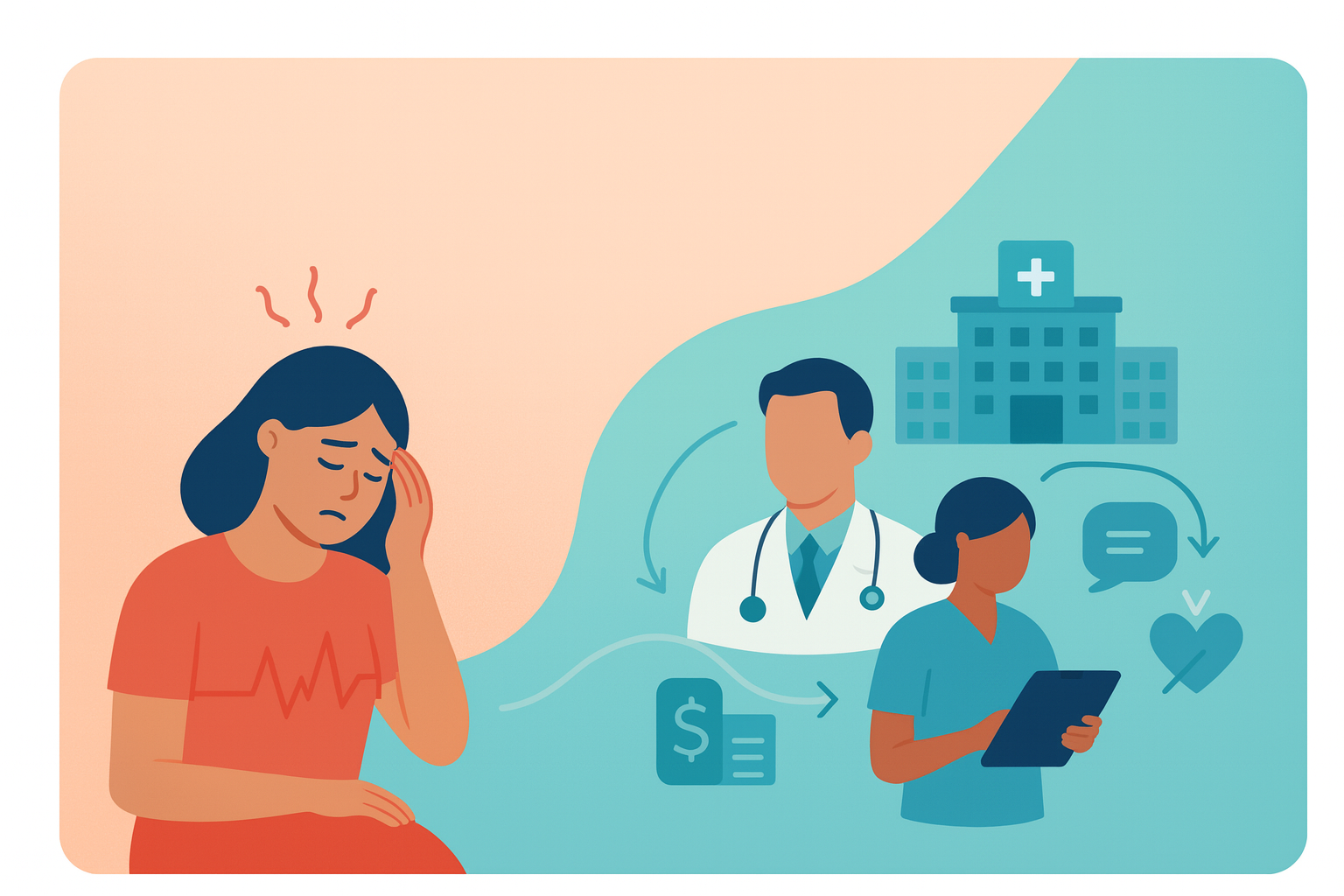
How Stress Affects Patients and Care Systems
Stress Hits the Patient:
- ↑ Blood pressure & heart rate
- ↑ Inflammation & immune suppression
- ↑ Risk for chronic disease & complications
- Lack of resources (financial, logistical, emotional, educational) amplifies stress (4,5)
Stress Hits the System:
- ↑ Hospitalizations & ER visits (6)
- ↑ Clinician burnout
- ↑ Administrative and care complexity
When patient stress is unaddressed, the system absorbs the downstream burden.
Why Patient Education and Resource Plans Matter
Patients can’t follow a plan they don’t understand, and in cancer care, misunderstanding can impact quality of life and potentially have life-or-death consequences (9,10). Even when health systems provide detailed information, patients are often scared, stressed, and overwhelmed, making it difficult to absorb everything in the moment (10,14).
Research insight:
Tailored education and clear information—delivered in ways patients can absorb—improves screening rates, treatment knowledge, and adherence (11,12). Coupled with access to practical resources, these supports reduce complications and improve long-term outcomes.
Why it matters:
Information overload is real. Patients may receive binders, handouts, or online resources, but recall and understanding are limited under stress. What makes the difference is reinforcement: the right information, at the right time, paired with guidance on where to turn for support (12,14). That shift turns “I think I understand” into “I know exactly what to do, and I know where to go for help.”
Education and resources aren’t one-time events—they’re ongoing interventions. When patients receive timely reinforcement and access to practical support, they’re better equipped to follow care plans, improving outcomes and reducing stress for both patients and health systems.
Partnering With Health Systems to Reduce Stress
Health systems already work hard to deliver comprehensive care, but patients often need reinforcement and resources between visits to stay on track. That’s where technology partnerships make the difference.
We Are Here extends and complements care teams by:
- Reinforcing education with tailored resources, guided questions, checklists, and multimedia tools (11–14)
- Timing support to match the patient journey, reducing overload and increasing retention
- Connecting patients and caregivers to financial, emotional, and logistical resources that complement the care plan
- Integrating care across mental, physical, and social needs for holistic support
- Reducing complexity by streamlining access to resources and navigation, so patients can focus on healing
- Ensuring continuity with ongoing follow-ups outside the clinic walls
Timely reinforcement and practical support help patients stay on track—improving outcomes and easing stress for patients, clinicians, and health systems alike. When stress is addressed at every level, care becomes more effective, equitable, and sustainable.
That’s the shift we’re here to drive.
About the Author
Shea Mencel is a Certified Integrative Health Coach, health equity advocate, and Co-founder & Vice President of Navigation at We Are Here. With a background in trauma-informed care, mind-body nutrition, and integrative wellness, she supports people with cancer in reclaiming power, clarity, and well-being, no matter where they are in the process. She is also a two-time breast cancer survivor.
Shea believes care should be bioindividual, holistic, accessible, and rooted in community, and that even the smallest changes in how we eat, move, and rest can make a powerful difference. You can learn more about her work at www.sheamencel.com.
References
1 Segerstrom SC, Miller GE. Psychological stress and the human immune system: a meta-analytic study of 30 years of inquiry. Psychol Bull. 2004;130(4):601–630.
2 Antoni MH, Lutgendorf SK, Cole SW, et al. The influence of bio-behavioural factors on tumour biology: pathways and mechanisms. Cancer. 2006;106(3):570–577.
3 Kim-Fuchs C, Poth JM, Waldner M, et al. Chronic stress accelerates pancreatic cancer growth and invasion: a critical role for beta-adrenergic signaling in the pancreatic microenvironment. Brain Behav Immun. 2014;40:40–47.
4 Lutgendorf SK, Lamkin DM, DeGeest K, et al. Depressed and anxious mood and T-cell cytokine expression in ovarian cancer patients. Clin Cancer Res. 2008;14(3):791–800.
5 Costanzo ES, Lutgendorf SK, Rothrock NE, Anderson B. Psychosocial factors and immune recovery in breast cancer patients: a longitudinal study. J Psychosom Res. 2005;59(5):277–285.
6 Heikkilä K, Nyberg ST, Theorell T, et al. Work stress and risk of cancer: meta-analysis of 5700 incident cancer events in 116,000 European men and women. BMJ. 2013;346:f165.
7 Lieberman MD, Eisenberger NI, et al. Putting feelings into words: affect labeling disrupts amygdala activity in response to affective stimuli. Psychol Sci. 2007;18(5):421–428.
8 Heitmayer M, Lahlou S. Effects of a smartphone digital detox on mood, anxiety, and sleep. Comput Hum Behav. 2021;119:106716.
9 Berkman ND, Sheridan SL, Donahue KE, et al. Low health literacy and health outcomes: an updated systematic review. Ann Intern Med. 2011;155(2):97–107.
10 Halbach SM, Ernstmann N, Kowalski C, et al. Unmet information needs and limited health literacy in newly diagnosed breast cancer patients over the course of cancer treatment. Patient Educ Couns. 2016;99(9):1511–1518.
11 Stacey D, Légaré F, Lewis K, et al. Decision aids for people facing health treatment or screening decisions. Cochrane Database Syst Rev. 2017;4(4):CD001431.
12 Durand MA, Carpenter L, Dolan H, et al. Do interventions designed to support shared decision-making reduce health inequalities? A systematic review and meta-analysis. PLoS One. 2014;9(4):e94670.
13 Beaver K, Campbell M, Craven O, et al. Patient perspectives on continuity of cancer care: experience and expectations. Eur J Oncol Nurs. 2007;11(4):289–296.
14 Mills ME, Sullivan K. The importance of information giving for patients newly diagnosed with cancer: a review of the literature. J Clin Nurs. 1999;8(6):631–642.